

ERP Isn’t All or Nothing: Smart Phased Rollouts Protect Your Project
Go “pro” or quit already. Get married or break it off. Run the Iron Man or stay on the couch.
Few things in life are all or nothing, and that is a good thing! Humans are “step-by-step” creatures who learn, try, and decide as we go.
Many companies assume ERP implementation is either all or nothing. But, does implementing ERP actually have to be a “Big Bang” scenario, a moment when one system ceases, and another awakens?
No, ERP is not all or nothing. In fact, implementing a company’s ERP gradually is both very common and typically beneficial. Smart, phased ERP rollouts have huge advantages over other implementation strategies (reduced risks, improved continuity, smoother stakeholder adoption, ect).
When companies attempt to turn off old systems and turn on their new one in a single, glorious moment (called the “Big Bang” approach), they are actually embracing tremendous risk. We will explore these implementation risks at length later on. A failed ERP “Go-Live” (or even a rocky implementation) can cripple a company, as many have witnessed firsthand.
If the “Big Bang” approach to ERP implementation is a too risky, then how should ERP implementation work? What is a sensible ERP implementation strategy?
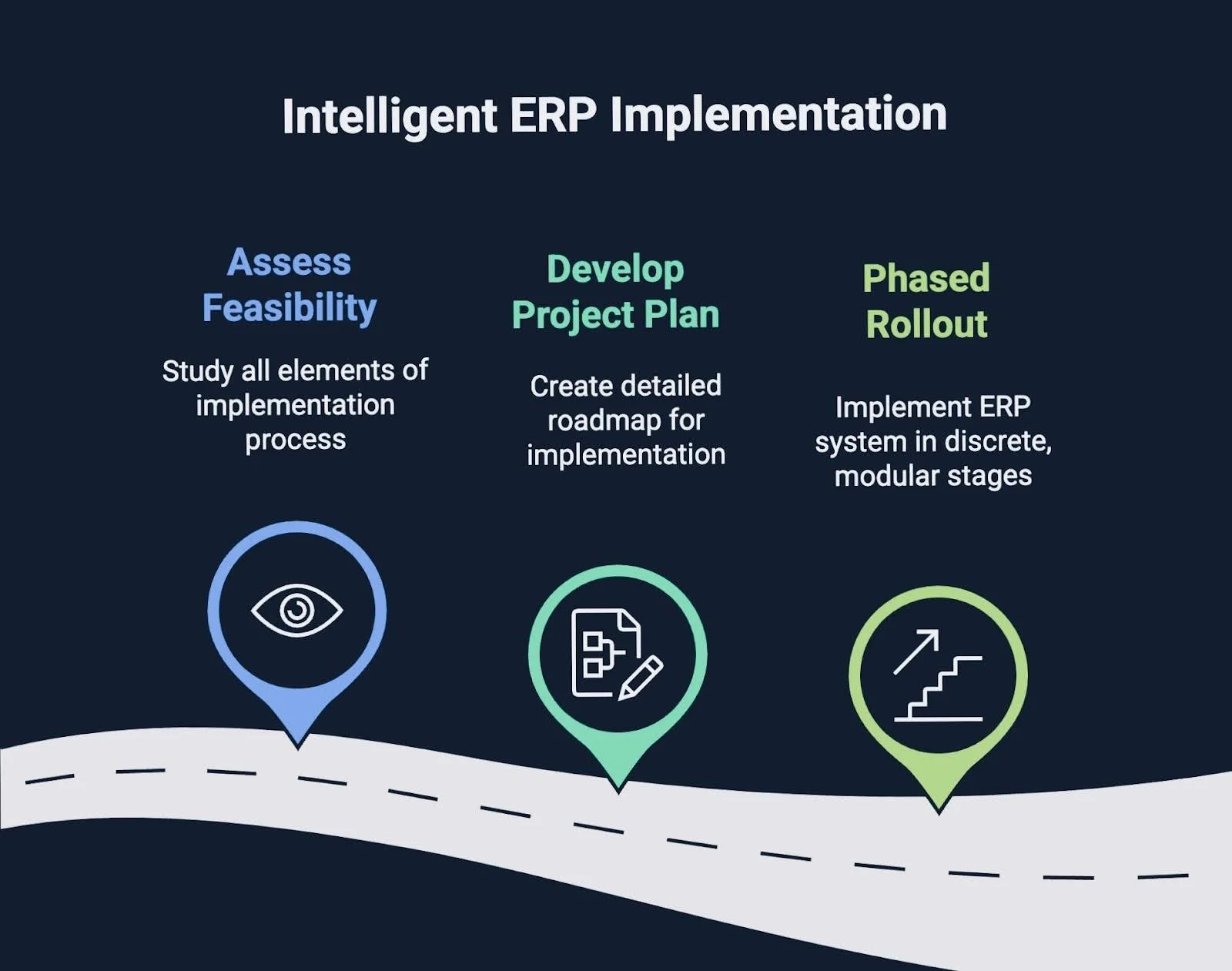
Intelligent ERP Implementation
The life-cycle of an excellent ERP implementation typically has three parts:
Part 1: Feasibility Study
Part 2: Project Plan
Part 3: Phased Rollout
Part 1 focuses on the question: “What needs to be done?”
Part 2 addresses: “How will we do it well?”
Part 3 is about: “Are we getting it done?”
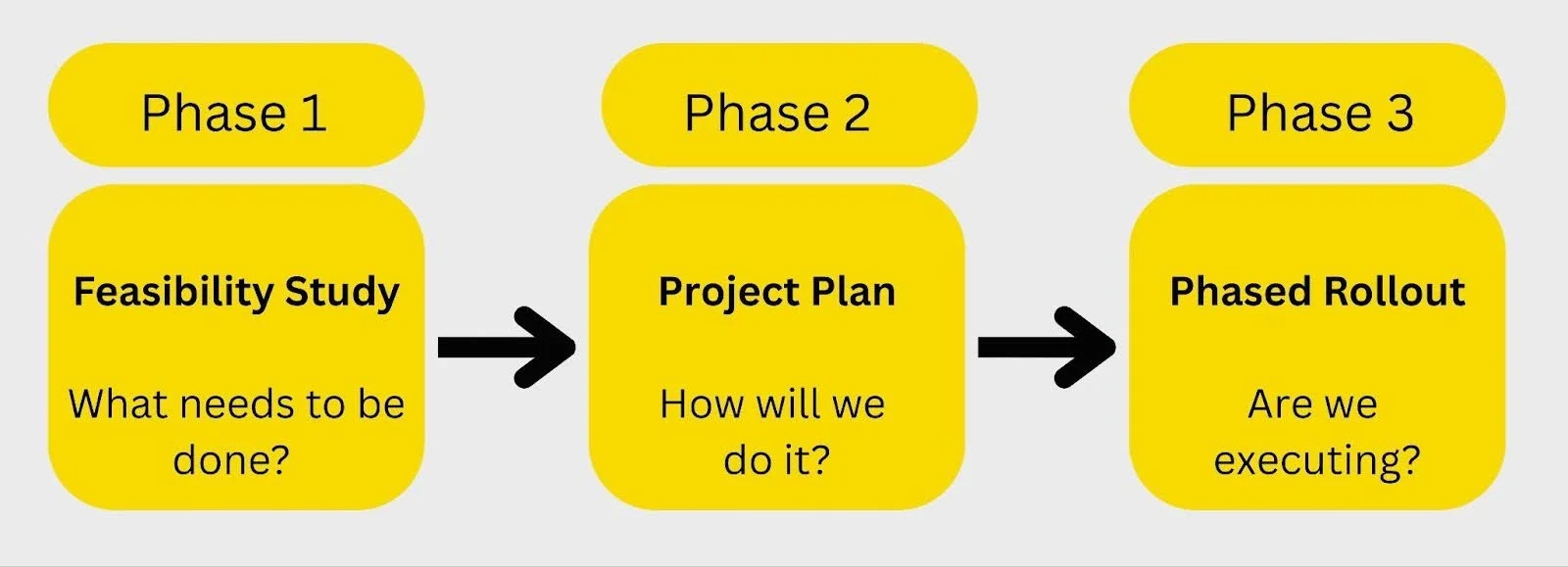
Excellent ERP Implementation must start with an early feasibility study and use the findings to craft a detailed project plan. A detailed project plan is the backbone of the implementation. The project plan informs the company’s step-by-step actions as they proceed with their implementation.
Let’s explore the three parts more thoroughly.
Feasibility Study
What is a feasibility study?
Feasibility Study: An examination of what will be required to comprehensively implement a chosen ERP successfully for a specific company.
Purpose of a feasibility study: Collect all the information needed to create a practical ERP implementation plan (or a project plan).
Trying to begin ERP implementation without first completing a thorough feasibility study is a recipe for disaster, like beginning to build a home before surveying the land.
A thorough feasibility study will:
Clearly define the scope of the ERP implementation
Ex. What is wrapped into this implementation project?
Measure an organization's appetite for transition to a new ERP system
Ex. How willing or reticent are staff to embrace the change?
Measure an organization's ability to transition to a new ERP system
Ex. What personnel resources can they dedicate to the transition (finance, operations, IT, and executive management)
A comprehensive feasibility study details every part of the implementation process and develops a detailed task list of everything that needs to be done. This will include the following tasks and many more!
Software Installation, configuration, customization and integration
Data cleansing and migration
Training
Testing
Additionally, a feasibility study makes an approximate calculation of the work hours required to complete each task in the process. Carefully estimating the amount of time it will take for every task is essential for:
calculating the timeline
determining if the current team requires help
limiting scope creep.
The final product of a feasibility study/analysis is a bulletproof, detailed project implementation plan. A detailed, realistic, and predictable project plan is the genius behind every smooth ERP implementation.
Project Plan
Why do you need an implementation plan?
Trying to begin ERP implementation without a good implementation plan is blunder. This would be like (staying with our previous metaphor) trying to construct a skyscraper in midtown Manhattan without a blueprint or permits – it is not going to end well for anyone.
A company needs a robust project plan to implement ERP in an organized, efficient fashion. What does a good project plan include?
A good project plan will include:
Well-defined ERP implementation phases
Each phase must include specific action-items and deliverables
Assignment of, and agreement on, roles and responsibilities
A comprehensive implementation timeline
Risk management protocols to keep the project from going sideways, like achievement checkpoints, system testing, and thorough training.
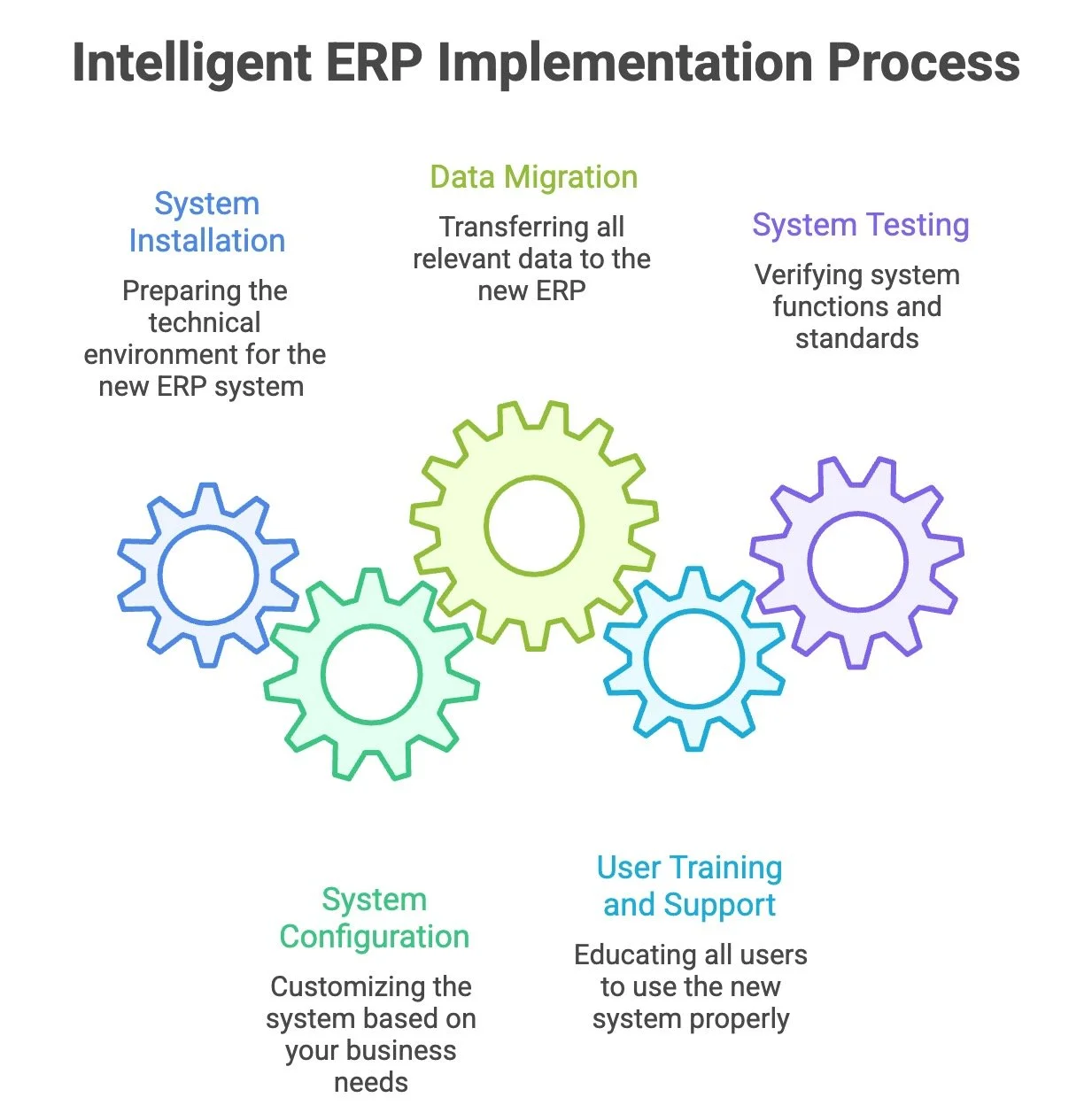
The project plan needs to go into great depth on the following processes:
#1 System Installation: Preparing the technical environment for the new ERP system
installing software components
setting up servers or cloud infrastructure,
#2 System Configuration: Customizing the system based on your business needs
define how different modules work together,
Establish how workflows operate, and
Design how users access data.
#3 Data Migration: Transferring all relevant business/customer data to the new ERP
Reviewing and cleaning existing data
Defining what data needs to be migrated
Establishing mapping rules between old and new formats
Validating migrated data for accuracy
Testing the migration process in stages before full transfer
#4 User Training and Support: Educating all users to use the new system properly
Training programs should be customized for different user roles.
User support during and after “Go-Live” is always needed.
Project team training, IT team training, Business user training, and Ongoing training
#5 System Testing: Running and troubleshooting in a controlled environment
Conference room pilot
Compliance and security testing
User acceptance testing
A detailed, fully agreed-upon project plan allows both the client and supporting VAR to begin implementation with eyes wide open and realistic expectations about budget, timeline, risks, configuration plan, and change management plan. The plan it is the roadmap that enables a successful ERP rollout.
Phased Rollout
With a detailed project plan in hand, responsible implementation can begin! Phased ERP implementation, though perhaps not as flashy as the “Big Bang” implementation strategy, is the way that the majority of companies should implement their ERP.
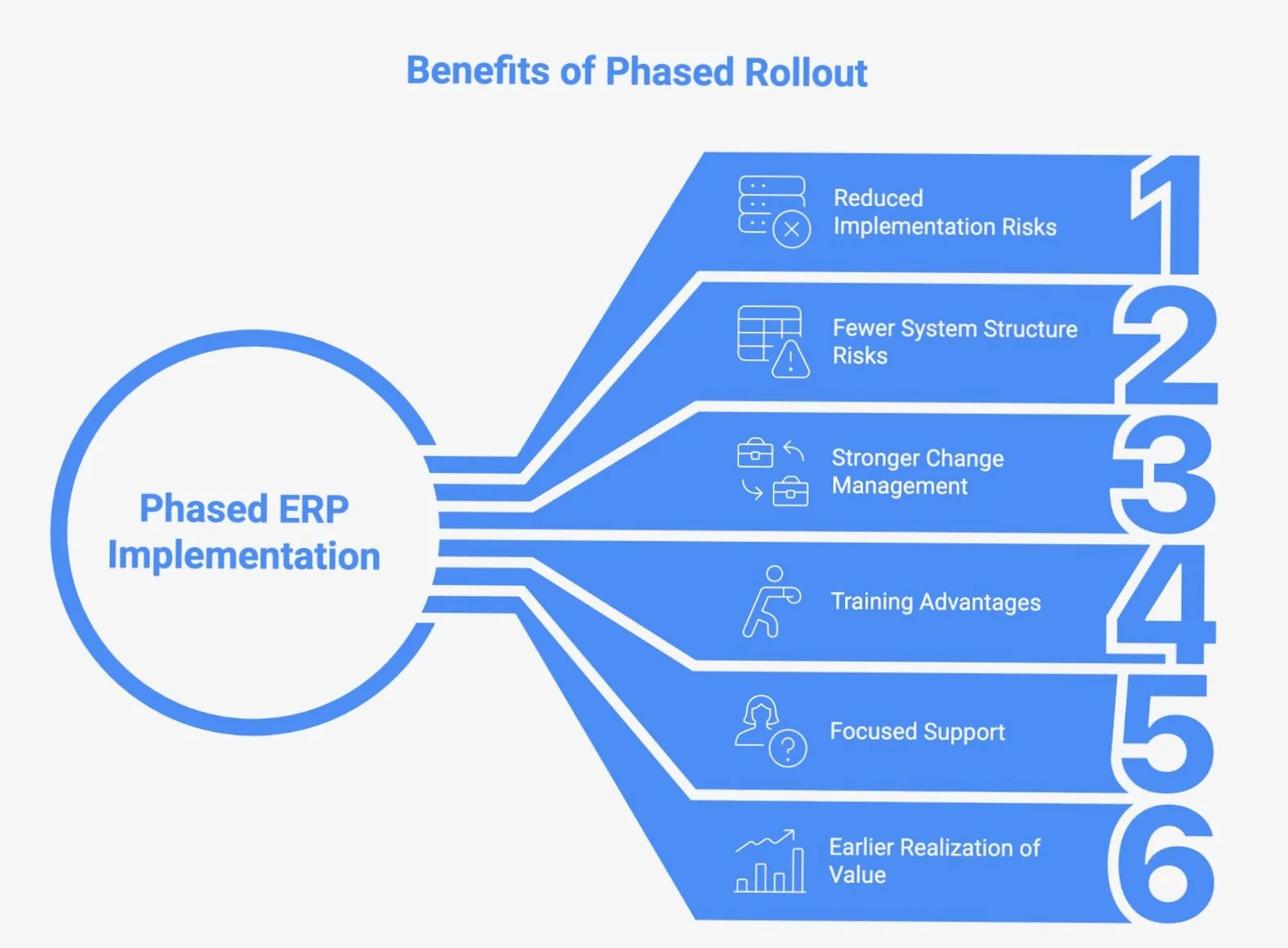
Phased ERP implementations offer several advantages, especially for Acumatica rollouts (which is our area of expertise). Let’s consider some of these advantages.
#1 Reduced implementation Risks:
“Big Bang” transitions often lead to widespread system downtime or failure. Phased rollouts inherently contain issues in a specific module or location.
#2 Fewer System Structure Risks:
Phased implementations often improve data migration accuracy. Data issues are less likely to occur when data is cleaned and migrated in smaller sets.
Better configurations are possible when Solution Engineers use feedback from early users to refine workflows and settings before scaling them.
#3 Stronger change management:
Phased rollouts allow companies to communicate to users about one thing at a time. Early wins increase user confidence, and users don’t need to adjust to dozens of new changes simultaneously.
#4 Training Advantages:
Training can occur in manageable stages. Project leaders and trainers can focus their time and not feel the burden of training everyone in everything at once.
#5 Focused Support
IT teams can focus on one module at a time and resolve issues before expanding the rollout.
#6 Earlier realization of value
Early phases can deliver benefits more quickly. Everything does not need to be completed before any value is realized for the company.
We Can Help
ERP implementation doesn’t need to be a leap into the unknown. In fact, it shouldn’t be. The smartest implementations we’ve seen didn’t try to do everything at once. They proceeded intentionally, with clear planning and multi-phased execution.
A solid feasibility study gives you the full picture. A detailed project plan with a realistic timeline keeps everyone aligned. And a phased rollout? That’s your insurance policy against revenue disruption.
By breaking the project into manageable phases, you give your team space to adapt, reduce disruption, and deliver value sooner rather than later.
So what does a smart phased scope actually look like for a business with multiple warehouses, commercial jobs with subcontractors, or a shop floor?
That’s exactly where we’re headed next, stay tuned as we explore how to shape phased ERP rollouts for high-complexity industries like manufact furing and construction.
TL;DR
ERP implementations don’t need to be “all or nothing.” Big-Bang go-lives carry significant risk and can severely disrupt a business. A smarter approach is a phased ERP rollout, guided by a thorough feasibility study and a detailed project plan. Phased implementations reduce risk, improve data quality and configuration, simplify training and change management, allow for focused support, and deliver business value sooner. By breaking ERP projects into manageable stages, companies protect operations, improve adoption, and greatly increase the odds of a successful ERP implementation.
References
https://bigbang360.com/big-bang-versus-phased-erp-implementation-strategies/
https://www.js3global.com/blog/business-erp-bang-parallel-phased/
https://wm-synergy.com/the-4-erp--types-to-choose-from/?utm_source=google&utm_medium=organic
https://www.opensourceintegrators.com/publications/essential-erp-implementation-phases
https://www.sap.com/products/erp/what-is-erp/erp-implementation-best-practices.html
Keywords:
Phased ERP implementation
ERP rollout strategy
ERP project planning
feasibility to implementation
Acumatica phased rollout
ERP implementation risks
ERP project scope management
ERP explained
ERP consultants
ERP consulting services